Showing posts with label Fiction. Show all posts

Saturday, October 25, 2014

Of Blood and Brothers: Book Two

by E. Michael Helms

To say this is the second in a series is a little bit of a stretch.  It is, however, the second half of a single novel.  Helms frequently refers back to events from his first book with no exposition of those events.  A reader not having read the first book would not pick up on these queues nor understand their inferences.  Consequently, “Of Blood and Brothers: Book Two” is merely a continuation of the original story and not a stand-alone book.

That aside I thoroughly enjoyed catching up with the stories of the Malburn brothers.  Daniel, fighting on for the Confederates and Elijah fighting with the Union Army during the Civil War, their reunion and the fiery aftermath of the early stages of reconstruction in the South.

The war is not the only thing dividing the Malburn brothers.  The love of a woman also pits Daniel and Elijah against each other in a love triangle.  We already know that Elijah is the brother who won Annabelle “Annie” Gainer’s hand in marriage, now we find out how that happened and what the fallout from that event was.  Needless to say the Malburn’s reunion at the war’s conclusion does not bring forth only tears of joy but tears of anguish as well.

Calvin Hogue, the newspaper reporter who brings the saga of the Malburn brothers to the readers of his uncle’s newspaper, is noticeably absent during most of this book.  His interactions with the brothers and other members of the extended Malburn family were part of the driving narrative of the first book in this series.  In this second installment he only appears in the beginning of the book, to restart the story, and at the end of the book, asking what became of the rest of the family.

Taken together, the two parts of “Of Blood and Brothers” is a great retelling of the Civil War, from both sides (though Eli is not a willing volunteer for the Union Army) and shows the horrors of battle and its aftermath, as well as life in the Northern Confederate Prison Camps.  In an interesting twist to the Civil War Fiction genre, Helms demonstrates that the conditions in Northern Prison Camps was just as bad as those in the South, such as Andersonville and Libby, which are overly portrayed in Civil War fiction.

Helms’ writes in a smooth, easily read style, and the story of the Malburn brothers is a compelling page turner.  I just wish it had been published as one book instead of being split into two, as each is weaker without its other half.

ISBN 978-1938467509, Koehler Books, © 2014, Paperback, 274 pages, $17.95.  To purchase click HERE.

Saturday, October 18, 2014

The Ones They Left Behind

By Antonio Elmaleh

Harriman Hickenlooper, a veteran of the 6th Iowa Infantry, came back from what some would call “The War of the Rebellion” and what others later would call the “War Between the States” with an unkept promise, a score to settle and a debt to repay.  His parents who had taken out a mortgage on the family farm had both died during the war; his brother Alonzo would also die in the war in Harriman’s arms.  It has been two years since Harriman had returned home.  The Appanoose County farmer was heavily in debt, behind on the mortgage payments and struggling to keep up the family farm all on his own.

Walter Ridley, formerly the Colonel of the 6th Iowa Infantry and now after the war was on the board of directors of the “Farmer’s and Merchant’s Bank,” Centerville, Iowa’s only bank, which held the note on the Hickenlooper farm.  In a move to avoid the embarrassment to bank foreclosing on one of Appanoose County’s war veterans, Ridley, bought the loan from the bank.

At a meeting of Centerville’s veterans, Harriman proposes a bet between he and Colonel Ridley; that Harriman could walk from Atlanta to Savannah, following the path taken by the 6th Iowa during William T. Sherman’s March to the Sea, unarmed, while carrying a United States flag, and return to Centerville unharmed by January 1, 1868 (giving Harriman 44 to complete the fete) with tangible proof of his journey.  If he makes it back by New Year’s Day he will get his farm free and clear, if he doesn’t Ridley will get the farm.

Seventeen year old Rufus Dewes, a young man wanting desperately to become a newspaper reporter, instantly senses Harriman’s journey would make a great story, and convinces Harriman to let him tag along on the journey.  Rufus periodically sends back dispatches to Jack Connolly, editor of Centerville’s newspaper, The Loyal Citizen, in which they are published.  The articles are quickly picked up by other newspapers across the country, and Harriman’s journey becomes a nationwide sensation as people clamor for details and wonder whether or not he will make it back in time, or even make it back at all.

Along the their journey Harriman and Rufus are joined by a former slave named Jed, emancipated in name only, until the timely arrival of the Northerners, and Lucinda McWhorter, a young Georgia woman left destitute by the misfortunes of war.  Will the quartet make it alive to Savannah?  And if they do will Harriman make it back to Centerville in time to save his farm?  And who are “The Ones They Left Behind?”  You will have to read the book to find out for yourself.

Iowa and family connections added to my experience of reading this book.  Being a native of south-central Iowa, I was greatly surprised to pick up Mr. Elmaleh’s book, and realize it was partially set in Centerville, a real town in Iowa, and county seat of Appanoose County.  My great Grandmother, Mary Alice Byrd Luce, is buried in Jerome, a small town just a few miles west of Centerville, so I am familiar with the area.  Centerville and the 6th Iowa Infantry are the only real things in this book; the bank, the newspaper, the townspeople, and the members of the 6th Iowa Infantry are all fictional creations of the author.  My father’s uncle, Lowell Miller, a medic during the Korean War, was killed in action and died in his brother’s arms, which reflected the story of Harriman and Alonzo, and gave to me an extra sense of poignancy to the story.  And further my great great grandfather’s name was Alonzo Luce, and three of his brothers served in the Union Army during the Civil War, all of them, however were in different units and did not serve together.

Mr. Elmaleh states he based his novel on a newspaper article about a real Civil War Veteran who retraced Sherman’s route from Atlanta to Savannah, but he does not reveal any details of the actual historical event.  “The Ones They Left Behind” is well written and engaging.  It is a quickly read page turner that I found myself unable to put down.

ISBN 978-0990640622, 21 Cent Imprints Llc, © 2014, Hardcover, 260 pages, $19.95.  To purchase click HERE.

Sunday, October 6, 2013

Hell Or Richmond

Hell or Richmond
By Ralph Peters 

In a series of battles between May 4 & June 24, 1864 the Army of the Potomac directed by Lieutenant General Ulysses S. Grant and commanded by Major General George G. Meade clashed with the Army of Northern Virginia, commanded by General Robert E. Lee, in what would later become known as The Overland Campaign.  The ferocity and near daily combat during those two months shocked the divided and warring nation. The combined casualties of both armies totaled over 88,000 men killed, wounded, captured or missing.  It was the last year of the war, a baptism of fire that lasted four long years, the beginning of its cataclysmic end, that would forge a new, united nation from its warring factions.

Best-selling author, Ralph Peters, uses the backdrop of The Overland Campaign for his novel, “Hell or Richmond.”  From the battles at The Wilderness, and Spotsylvania Court House to The Battle of Cold Harbor Peters graphically covers much of The Overland Campaign.

Officers such as Ulysses S Grant, General-in-Chief of the United States Army; Major General George G. Meade, commander of the Army of the Potomac; and Francis Channing Barlow, the Union’s Harvard-valedictorian “boy general,” as well as Confederate General Robert E. Lee, Major General John Brown Gordon, and William C. Oates, Colonel of the 15th Alabama Infantry take their places in Mr. Peters’ narrative beside the enlisted men of both armies.

Historical fiction fills the gaps where its counterpart, nonfiction, cannot go.  Peters’ narrative breathes life into his the men of our historical past, and viscerally reveals the life of a civil war soldier before, during and after a battle; the hunger, the dirt and grime, the smell, the blood and gore.  Where more often than not historical fiction authors fail, Peters excels and does not hold back with his bloody and gory descriptions of wounds received by 18th century projectiles.  His dialogue is sometimes salty and profane, but nevertheless rings true of combat veterans.

Ralph Peters’ “Hell or Richmond” masterfully combines descriptive narrative and coarse dialogue which doesn’t sound as if had been vetted for a prime-time television viewing audience, and successfully transports his 21st century readers to the unpleasantness of the summer of 1864 Virginia.

ISBN 978-0765330482, Forge Books, © 2013, Hardcover, 544 pages, Maps, $25.99.  To purchase this book click HERE.

Monday, September 30, 2013

Calvert the Raven in The Battle of Baltimore

Written & Illustrated by Jonathon Scott Fuqua

Daniel is a young elementary student who is bored by history.  It puts him “asleep.”  He is so bored by history that on his latest homework assignment, a report on the War of 1812, he makes things up to enliven it which has earned him a grade of “Terrible!” scribbled across the top of the page by his teacher.  Despondently he begins the long walk home and he worries that his Mom and Dad will be furious with him.

Daniel’s walk of shame is interrupted by a talking raven named Calvert, who can’t believe that Daniel thinks history is boring.  Upon the urging of Calvert, Daniel touches his wing and mysteriously finds himself shrunken, riding on the back of Calvert and being transported backward through time to 1814 and the Battle of Baltimore.

Swooping among the soldiers and sailors, over land and water, through bullets, rockets and the blue-gray gunpowder smoke Calvin and Daniel witness the battle and the Bombardment of Fort McHenry, and back to the future to see that Daniel gets home in time for supper.  Before he departs Calvert urges Daniel to go home and rewrite his paper, even if his teacher does not change his grade.  With a new outlook on history Daniel can’t wait to get home and do just that.

Calvert the Raven in The Battle of Baltimore is a delightful book for children.  It’s alternating pages of text and very well executed illustrations are bound to draw in young readers and leave them with the knowledge that history is not boring.

ISBN 978-1610880770, Bancroft Press, © 2013, Hardcover, 32 Pages, 10.8 x 7.4 x 0.4 inches.  $17.99.  To Purchase the book click HERE.

Saturday, April 27, 2013

A Blaze of Glory: A Novel of the Battle of Shiloh

By Jeff Shaara

After authoring novels on the American Revolution, the Mexican War, World War I, and World War II, Jeff Shaara has found his way back to the conflict that launched his literary career, the American Civil War.  After penning a prequel and a sequel to his father, Michael Sharra’s Pulitzer Prize winning novel, “The Killer Angels,” Mr. Shaara now begins a new Civil War trilogy with “A Blaze of Glory: A Novel of the Battle of Shiloh.”

Shaara in “A Blaze of Glory” maintains the tried-and-true format of his and his father’s previous novels: using multiple characters and points of view, to give his reader a more-or-less balanced narrative of the Battle of Shiloh.  Major General Ulysses S. Grant, Brigadier General William Tecumseh Sherman, Brigadier General Benjamin Prentiss and Private Fritz Bauer of the 16th Wisconsin Infantry are the primary characters on the side of the Union.  Their Confederate counterparts are General Albert Sidney Johnston, Tennessee Governor Isham Harris and Lieutenant James Seeley of Nathan Bedford Forrest’s Confederate Cavalry.

“A Blaze of Glory” begins in late February of 1862 with the building up the Confederate forces at Corinth, Mississippi, where the Mobile & Ohio Railroad intersects with the Memphis and Charleston Railroad; and that of the Union forces some twenty-two miles to the northeast at Pittsburg Landing, on the Tennessee River.  Ulysses S. Grant, commander of the Army of Tennessee has been assigned to hold there until joined by Don Carlos Buell’s Army of the Ohio.  Once the two Federal Armies have united only then are they to launch an attack on the vital Confederate hub at Corinth.  Aware of the impending danger of two Federal armies bearing down upon his forces, Johnston determines to launch his Army of Mississippi a surprise attack and defeat Grant’s army at Pittsburg Landing  before Buell’s joins with it.

Thus with all of his chess pieces set into place Mr. Shaara’s narrative, switching between the Union and Confederate armies, gradually picks up steam as the Confederate army, slowed by weather delays and muddy roads, nears the Union camps at Pittsburg Landing.  For those educated on the battle and its controversies, Mr. Shaara covers familiar ground: the surprise, or lack thereof, of the Confederate attack, the positioning of the camps (specifically those of the new, little trained regiments), the changing battle plans of the Confederate Army and who authored them, the death of Albert Sidney Johnston and the ascension of P. G. T. Beauregard as his successor, the “Hornet’s Nest,” Beauregard’s decision to withdraw the Confederate troops out of range of the Union guns on the evening of the first day of the battle and Lew Wallace’s late arrival onto the battlefield.

Mr. Shaara places particular credit to Prentiss’ delaying action at the “Hornet’s Nest” for the eventual success of the Union army on the second day of the battle, giving Grant enough time to form a stronger line, reinforced by the timely arrival of Buell’s army at the river landing.  I suspect this was done for dramatic purposes, as modern scholarship currently places more importance on Sherman’s fighting at the crossroads near Shiloh Church.

The book’s thirty-seven chapters are spread almost equally between the two opposing armies; 19 chapters for the Union and 18 chapters for their Confederate opposition.  Albert Sidney Johnston is the most featured character in the novel with 10 chapters, followed by Sherman and Bauer both with 8, Seeley at 5, Harris with 3, Grant, commander of the Union forces, strangely with only 2 and Prentiss with 1.

The novel is thoroughly researched, Mr. Shaara states in that he uses only original sources from people who were there.  It is well written and easy and enjoyable read.  Whether you are an advanced student of the Civil War or a casual reader of novels you will be entertained, and might just learn a little something along the way.

“A Blaze of Glory” is the first in a new Civil War trilogy, authored by Jeff Shaara, covering events in the war’s western theater.  The second volume of the series, “A Chain of Thunder: A Novel of the Siege of Vicksburg,” will be released May 21, 2013.  The third volume in the trilogy will focus on Sherman’s March to the Sea and the Carolina Campaign.

ISBN 978-0345527356, Ballantine Books, © 20012, Hardcover, 464 pages, Maps, $28.00.  To purchase this book click HERE.

Sunday, April 21, 2013

Shiloh: Book 2 of “The Civil War Battle Series”

By James Reasoner

James Reasoner continues the saga of the Brannon family of Culpepper County, Virginia, in “Shiloh,” the second installment of “The Civil War Battle Series.”

“Shiloh” picks up shortly after the conclusion of “Manassas,” the first book in Mr. Reasoner’s series, continuing the story of the Brannon family with the only member of the family we have not yet met, Coriolanus Troilus Brannon, the wayward son of Abigail Brannon.  Before the war he travelled west to find his fortune.  Things haven’t gone as well as he had hoped.  When the book begins Cory is a day laborer working on the wharfs of New Madrid, Missouri on the Mississippi River.  He is dirty, hungry and homeless.

Through a series of unfortunate events Cory is rescued by Ezekiel Farrell, captain of The Missouri Zepher, a river boat which frequently traverses the Mississippi River from New Orleans to Cairo, Illinois.  When Cory warns the captain that a torch-bearing crowd of abolitionists is on its way to burn the Zepher, Captain Farrell decides to quickly depart from New Madrid, and as thanks for the warning allows Cory to come along.  But Cory is not the only youngster onboard the Zepher, the Captain’s daughter, Lucille, is also aboard.

Cory spends the next few months on board the Zepher, travelling up and down the Mississippi River, learning the river and its hazards all the while falling in love with Lucille.  But in early 1862 Cory’s past catches up with him, and sends him, and the Zepher, fleeing from New Orleans with a cargo of cotton bound for Cairo and a shipment guns for the Confederacy.  After the cargo is delivered, Captain Farrell seeks the safety of Fort Henry on the Tennessee River, but that isn’t far enough, the Union Flotilla is on its way.  Farrell sends Lucille to live in the safety of the home of her uncle and aunt, Charles and Louise Thompson, in Nashville, while Farrell and the crew of the Zepher stay to help defend the fort.  It is a disastrous decision, the Zepher and her crew are lost and only the Captain and Cory make it safely back to shore and eventually twelve miles over land to Fort Donelson where Captain Farrell is killed in Grant’s attack on that fort.

Many of Nashville’s citizens, including Lucille and the Thompsons have fled the city ahead of the occupying forces of the Union army.  After arriving in the city Cory fruitlessly looks for Lucille, and unable to find her heads to Corinth, Mississippi, where he volunteers, temporarily, and fights with Nathan Bedford Forrest’s cavalry during the battle of Shiloh, his third battle in as many months.

Though most of Mr. Reasoner’s narrative concentrates on Cory Brannon, he briefly catches his readers up on what has been going on with the rest of the Brannon family: Will is still with the Confederate army; Titus, pining for Polly Ebersole has turned to alcohol to sooth his broken heart; Henry’s shoulder has healed; and Mac has captured and tamed the mysterious wild stallion and had decided he will soon join the Confederate army.

As with Mr. Reasoner’s previous book, “Shiloh” is a simple story told simply.  There is not much in the way of character development; the novel is purely a plot driven vehicle.  Though, there is more action in this novel than in the previous one, it is all in its last hundred pages: The attack on Fort Henry doesn’t occur until page 265.  Over all it is a satisfying novel, it is neither good, nor bad, but falls somewhere in the middle.

ISBN 978-1581820485, Cumberland House Publishing, © 1999, Hardcover, 362 pages, $22.95.  To purchase click HERE.

Sunday, March 31, 2013

Review: Manassas: Book 1 of “The Civil War Battle Series”

By James Reasoner

“Manassas,” the first book of James Reasoner’s ten volume, “The Civil War Battle Series,” introduces the Brannon family of Culpepper County, Virginia.  The patriarch of the family, John Brannon, an Irish immigrant with a penchant for reading Shakespeare, died in 1851 leaving his wife Abigail to raise their family of six children: William Shakespeare, MacBeth Richard (“Mac”), Titus Andronicus, Coriolanus Troilus (“Cory”), Henry and Cordelia.

The novel begins in January, during the “Secession Winter” of 1861.  Abraham Lincoln was elected President of the United States the previous November. As the states of the South begin to secede from the Union and form a new country the Brannon family anxiously await Virginia’s decision to remain in the United States or to leave the Union and join her sister states in the Confederacy.

Will, the eldest child of the Brannon clan, and the central character in Mr. Reasoner’s novel, is the Sheriff of Culpepper County.  Will suspects the Fogarty brothers for a series of robberies and murders in the county, including the murder of his deputy Luther Strawn.  When Will corners Joe Fogarty in the general store and is forced to shot and kill him for resisting arrest, a feud erupts between the Brannons and the remaining Fogarty brothers.

When the Brannon’s barn is burned to the ground their neighbors gather on the Brannon farm for a barn raising during which Henry Brannon is shot through the shoulder by a hidden gunman.  Abigail, a Christian woman strong in her beliefs, blames Will for the violence that has been brought to bear on the family and disowns him, banishing him from the farm.

Abraham Lincoln’s call for 75,000 troops to be raised after the surrender of Fort Sumter results in Virginia’s secession from the Union, and in an attempt to focus the attention of the George and Ransom Fogarty away from the rest of the family Will enlists in the 33rd Virginia Infantry to fight with the Confederate Army.  The Fogarty’s also enlist, seeing their opportunity to kill Will during a battle and avoid the suspicion of murder.  Together they march to battle the Yankee army, and each other, on the fields of Bull Run, near Manassas, Virginia.

Reasoner’s novel is a simple tale told simply.  Its linear narrative is mainly a plot driven vehicle with little character development, but all in all, still an enjoyable read.  Anyone looking for an in depth treatment of the First Battle of Manassas (or Bull Run, as the Union Army would later refer to it) should look elsewhere, as the battle does not begin until page 316 of this 336 page book.

ISBN 978-1581820089, Cumberland House Publishing, © 1999, Hardcover, 336 pages, $22.95.  To purchase click HERE.

Saturday, January 12, 2013

Hiram’s Honor by Max R. Terman

By Max R. Terman

It is the dream of most genealogists to travel backwards in time and interview their ancestors.  I suspect Civil War reenactors share a like dream of traveling through time to experience the life of a Civil War soldier as it really happened.  In his novel, “Hiram’s Honor,” Dr. Terman, a retired zoology professor, relives the horrors of the Civil War through the eyes of his great uncle, Hiram Terman, a private in Company F of the 82nd Ohio Infantry.

Based on ten years of research Dr. Terman assumes the personage of his great uncle, and uses a first person narrative to tell Hiram’s story.  From Hiram’s enlistment, and battlefield experiences, to his capture by the Confederate Army during the first day of Gettysburg, and imprisonment in such notorious Confederate Prison Camps as Belle Isle and Andersonville, Dr. Terman has unearthed the bones of Hiram’s military service and clothed them with his years of research to build a fully fleshed out narrative of what Hiram Terman’s Civil War experiences may have been.

Early on Hiram meets two friends, Seth who wears his religion on his sleeve, and Isaiah, an agnostic.  On the religious scale Hiram seems to float somewhere in the middle.  Throughout the novel the debate over religion, and the beneficence of God is a constant theme.

I found the first half of the novel a bit tedious as Hiram and his pards see action at McDowell, Cross Keys, Cedar Mountain, Second Bull Run, Chancellorsville, and Gettysburg where the three friends are captured on the first day of the battle as they retreat through the town.  The strength of Dr. Terman’s narrative grows in the second half of the novel, as Hiram and his friends are sent first to Belle Isle, an island prison camp in the middle of the James River, and then to the living hell of Andersonville.  It was compelling to read how Hiram and his friends learned how to survive, and it instantly reminded me of MacKinlay Kantor’s Pulitzer Prize winning 1956 novel and the 1996 film which it inspired, as well as John Ransom’s Andersonville Diary.  That is high praise indeed!

Published by Tessa Books (I could find almost no information about them on the internet), this book has an amateurish look to it.  The formatting is not what I would expect from a quality publisher; the text is a small, I would guess 9 or 10 point font, leaving very little “white space” on the books pages, and the book contains numerous photographs and maps, and the end of each chapter that would serve the reader better if they were interspersed throughout the text.  But these are very minor complaints.

All in all, despite its few minor flaws, if Dr. Terman, has not managed to make time travel into a reality, he has done something very much like it. 

ISBN 978-0615278124, Tesa Books, © 2009, Paperback, 242 pages, Maps, Photographs, Illustrations, Historical Notes & Acknowledgments. $16.99.  Click HERE to purchase this book.

Sunday, May 8, 2011

The Spellmans Strike Again

By Lisa Lutz

I am a big fan of Janet Evanovich’s Stephanie Plum series, after all it isn’t very often one runs across an author that you can honestly say is laugh out loud funny.  Lisa Lutz can rightfully take her place next to Ms. Evanovich on that very small list.  But what truly sets Lisa Lutz apart from Janet Evanovich is her ability to let characters grow and develop from book to book, where Ms. Evanovich has taken a somewhat safer more lucrative path of “if it ain’t broke don’t fix it.”  To put it quite simply, Evanovich’s characters, Stephanie et al, are stuck in a rut, that either Evanovich doesn’t know how, or doesn’t want to get them out of.  Lisa Lutz isn’t afraid to take chances with her characters.

“The Spellmans Strike Again” is the fourth in Lutz’ series about a family of private investigators who just can’t help investigating each other.  Thankfully just as with Janet Evanovich, each book stands on its own merits.  It’s not a prerequisite that you read the previous three volumes before picking up the fourth; though Ms. Lutz does deserve an honorary marketing degree for cleverly referencing the other works in the series with footnotes.

Part of the fun of the Spellman books, is that nothing stays secret for long in this family, and in this book, as in all the others, there is a cat and mouse game of who is keeping a secret from the rest of the family, and who is trying to uncover it; additional mysteries the Spellman’s clients provide are merely a side show, the real show is the Spellman family.

Lutz manages to flawlessly juggle multiple story lines: Isabelle (a.k.a. Izzy) Spellman, the main protagonist of Lutz’ series, is taking over the family business from her parents; she’s been hired to find a rich client’s butler, meanwhile she busies herself by spying on a rival P.I., and trying to unravel the mystery of the Spellman home’s disappearing light bulbs, door knobs and fixtures.  In her off time, Izzy is being blackmailed by her mother, and forced to date a series of very eligible, bachelor lawyers, a fact her current boyfriend is not too happy about.  Lutz manages to keep all of these balls in the air and just as a juggler catches each ball at the end of his routine, Lutz neatly ties up all of her story lines, one by one, as each is resolved.

ISBN 1416593403, Simon & Schuster, © 2010, Hardcover, 388 pages. $25.00

Monday, April 21, 2008

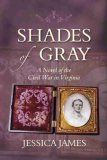
Shades of Gray


"You think I think that an artist's job is to tell the truth," says U.S. Poet Laureate, Tabitha Fortis, in an episode of The West Wing. "An artist's job," she continues, "is to captivate you for however long we've asked for your attention. If we stumble into the truth we got lucky."

One may think that's a pretty bold quote to start of a book review, and it may be, but this reviewer was certainly captivated by Jessica James' Shades of Gray: A Novel of the Civil War in Virginia.

With her use of two diametrically opposed perspective points, Ms. James has successfully drawn the historical fiction and romance genres together and created a multi-dimensional picture. She begins with broad strokes of her pencil and sketches the outlines of two characters. The first, Andrea Evans, clothed as a boy known as Andrew Sinclair, is a scout and spy for the Union Army. The second, Captain Alex Hunter, the dashing and noble Confederate Cavalry officer who would like nothing more than to capture and kill his nemesis, Sinclair.

A novelist must ask his or her readers to suspend their disbelief and accept the world as the author has presented it to them. In the first few chapters of "Shades of Gray" I found it hard to suspend my disbelief; the plot twists and machinations which draw Ms. James' two characters together seem a bit contrived and forced. But, once Andrea finds herself confined to Captain Hunter's home the artist's rapid strokes of her pencil revealed to me all that came before was mere background to a much more intimate picture she was trying to draw.

Next Ms. James slowly begins the delicate job of drawing sharper lines and defining her characters through their conflict. Both believe strongly in the cause for which each is fighting, both have very strong opinions about the opposing sides and often the two characters seem to be at war with one another.

With an artist's touch she begins to smudge and gently soften the harsher outlines of her subjects. As affection grows between the Union spy and her dashing Confederate cavalryman, Jessica James' transforms her characters with small strokes of her pencil, intricately drawing in detail, shading darker here and or lighter there.

The reality of the outside world cannot be held back in a country torn apart by civil war, and the divided loyalties of Ms. James' carefully crafted subjects threatens to tear them apart. With an artist's gift she draws her audience into making assumptions about her subjects, and demands them to look closer at the picture. With a guiding hand, Ms. James allows her readers to discover that the picture they thought they were seeing isn't really the picture she has drawn at all.

In Shades of Gray, Jessica James' skills as an artist are unquestioned. She as drawn a picture filled with conflict and love, loyalty and betrayal, history and romance, and a passion of lives lived in the moment. And along the way I think she may have also stumbled into truth.

Tuesday, August 8, 2006

Sideways: A Novel

Sideways: A Novel  
by Rex Pickett

Screenwriter Rex Pickett's debut novel, Sideways, reads like the debut novel of a screenwriter who longs to be a novelist. The problem is he lacks the attention to detail that would have turned his episodic tome into at least a mediocre novel.

The book's narrator, Miles Raymond, is a divorced and largely unsuccessful writer who is on the on the precipice of success which, has up until now, evaded him. Yet instead he seems to be standing on the precipice of a literary cliff, unwilling to lean too far over the edge for fear of plunging to his death. He is however, a lover of the grape, a wine connoisseur, who, as it happens, loves wine a little bit too much for his own good.

Miles' ursine best friend, Jack, is a successful actor and womanizer, who is to be married in a week. In fete that would please the most the discriminating literary horticulturalist, Pickett has managed to mate two standard Hollywood film genres (the bachelor party and the road trip) into one hybrid novel. Miles and Jack set off on a week long road-trip-bachelor-party through the California wine country. Along the way they meet two women, Maya, who has taken an interest in Miles and her friend Terra, whom gets Jack's attention.

Where this book falls flat is its mind boggling lack of details... what do we really know about the characters? Not a whole lot. We know that Miles is a writer, but we don't know what he writes or what he as written. We know that he has been divorced for a year, but still has not gotten over his ex-wife, Victoria. We know that Jack is a successful actor, but there is not one mention of a show or movie he was in, and even more of a mystery, if he is such a successful actor, why then does no one recognize him? We know he is going to be married to Barbara in a week. We know that Maya is a waitress and Terra works at a winery but we know precious other details of their lives. We know that every character loves wine, and as such wine is almost another character in the novel, but there is almost no description of the wine making process or what makes one wine different from another. And lastly, for a book that is set in the California wine country there is precious little descriptions of it, its landscape or its typography.

In short, Pickett has succeeded in writing a novel of a screenplay before the screenplay was even written. Do yourself a favor, skip the novel and go right to the movie as this is one of the rare instances where the movie was actually better than the book.

Sunday, April 24, 2005

Savannah, or A Gift For Mr. Lincoln

Savannah, or A Gift For Mr. Lincoln
by John Jakes

When writing reviews I usually try to put them at a length of about 500 words, give or take a few. However, upon contemplating this review of John Jakes' latest work of historical fiction, "Savannah, or a Gift for Mr. Lincoln," I think I would find it difficult to find 250 words to say about it much less 500. I anxiously await the release of any new John Jakes novel. I was slightly disappointed by "Charleston" as not meeting previous John Jakes standards, such as "The Kent Family Chronicles" or his masterwork, the "North and South" trilogy. So imagine my surprise when my slight disappointment with "Charleston" turned into extreme disappointment with "Savannah."

I can really say nothing about the plot of "Savannah" as after having read it, I remember precious little of anything that happened between its covers. I dare any John Jakes reader to say that about any of his other books. But what I do remember of the story centers around 12 year-old Hattie Lester's attempts to save her family's plantation, "Silvergrass," from the soldiers of Union General William T. Sherman, who have arrived just outside of Savannah from their march through Georgia in December of 1864.

Only half of my disappointment in "Savannah" lies at the foot of John Jakes himself. It is too simplistically written. His characters are underdeveloped and there is next to no plot. At best "Savannah" should be called a short story. It does not by any means or stretch of the imagination live up to the John Jakes works of the past, in which the writing is good, the characters fully developed, and the plotlines, though somewhat resemble modern day soap operas, are often interconnected. Indeed, "Savannah" seems to have been written for the young reader of between 10 or 12 years old, and if that is the case then Mr. Jakes can and should be forgiven.

I reserve the other half of my disappointment in "Savannah" to the publisher, Dutton. As sited above, "Savannah" is in reality a short story, and the editors of Dutton have done their best to lengthen it into a full-fledged novel, or at least something that resembles a novel.

First I'll tackle the size of this book. All of my other hard cover John Jakes books measure 9.5" x 6.5" while  Savannah comes in at a wimpy 8.5" x 6" and when placed on a shelf next to her sister John Jakes novels, she appears to be slightly out of place.

Secondly, Dutton has succeeded in lengthening "Savannah" to a novel of 288 pages, not only by the reduced size of this book as already stated, but by using a substantial font size and line spacing to give the book lots of "white space," and they also threw in a couple of illustrations for good measure as well.

Thirdly, if my theory of John Jakes writing this novel for a much younger audience is correct, I then fault the marketing department at Dutton for not marketing it as such. Even if this was marketed as a children's book many John Jakes fans, such as myself, would have purchased the book because it was a John Jakes book with the full knowledge that it was written for children and would not have been disappointed at all by it.

And lastly, Dutton further aggravated my disappointment in this book by its inflated cover price of $23.95. I refused to buy it at that price, even though it was a John Jakes book, and waited until it was 50% off to buy it at my local book store, and even then I felt like I had been robbed.

But the question is can I recommend this book. Well that's a tricky question to answer and my recommendation would depend on who was asking me. If you are a die-hard John Jakes fan who froths at the mouth at the mere mention of a new John Jakes book hitting the shelf, then yes, I would recommend it, with the reservation that the book is geared to a younger audience, and as such the characters and plots are much simpler than regular John Jakes fare. If you are 10 to 12 years old with an interest in the Civil War, I would recommend this book for you, as it seems to have been written with younger readers in mind. But if your are an avid reader of historical fiction where fully developed characters struggle to over come adversities of their time, and revel in the detail of such, no I would not recommend this book. And to the casual reader, I offer, "read it. You might like it, but don't blame me if you don't."

Okay so I did have more than 250 words to say about "Savannah." This review came in at 805 words.

Sunday, September 26, 2004

Rise To Rebellion

By Jeff Shaara

If you walked up to the average American standing on the street and asked them on what date The Declaration of Independence was signed the most likely answer you would get is "Everyone knows that, July 4th, 1776." Or try asking him "Which hill was the Battle of Bunker Hill was fought on?" I'll give you a hint... it wasn't on Bunker Hill.

The fact is that many Americans carry around these types of iconic myths regarding the era of the American Revolution. Jeff Shaara's fourth novel, "Rise to Rebellion," the first of two books to cover the period of the American Revolution, dispels many of these myths.

Spanning six and a half years, beginning with the Boston Massacre on March 5th, 1770 and ending with the signing of the Declaration of Independence on August 2nd, 1776, Mr. Shaara follows the lives such noted historical personalities as Benjamin Franklin, Samuel Adams, John and Abigail Adams, George Washington, Thomas Gage, Thomas Hutchinson, John Dickinson, Thomas Paine and John Hancock as they struggle to further their causes, both for and against, the independence of the American colonies from the rule of the British crown.

Once again, using his father, Michael Shaara's, tried and true method of multiple view points we view events such as the Boston Tea Party, The Battles of Lexington & Concord, and the Battle of Bunker Hill through the eyes of the characters who participated in the actual historical events. The genius of the Shaara formula lies not only within the shifting viewpoints but in the balanced approach to the material, not only concentrating on the American point of view, but also that of the British. He also shows the military struggle between the two sides and the political and diplomatic struggles of both sides as well - most notably following Benjamin Franklin as he navigates the stormy political seas of the British Parliament and the royal court of King George III. To balance military, political, diplomatic and social history is a difficult task and yet Shaara has succeeded masterfully at it.

However the one drawback of "Rise to Rebellion," and one that I fear Jeff Shaara will never break free of, is that of the formulaic structure of the book itself. Alas it is the alternating, multiple viewpoint structure that he inherited from his father, Michael Shaara, author of the Pulitzer Prize winning, The Killer Angels. Though it works well to provide a well balanced view of the contrasting sides, it impedes the author from trying a more literary approach to his story telling.

Mr. Shaara's novel is a sweeping, yet balanced, panorama of the people and events which gave birth to the United States of America and is worthy of its place on the bookshelf of American historical fiction

Wednesday, March 31, 2004

Homeland

By John Jakes

At a time when the world stood on the brink of a new century, America struggled to find its place upon the global stage, and huddled masses of immigrants streamed across its borders with little more than the clothing on their backs and a yearning to breathe free. It was a time of innovation and invention, a birth of a new technological age, when labor collided violently with management; fathers with sons and America found itself in a war to set a country free.

"Homeland," John Jakes' epic tome is not set during the turbulent decade of 1990's (as one might expect after having read my introductory paragraph) but rather a full century earlier. Beginning where his "Kent Family Chronicles" left off in 1891, and ending in the first year of the twentieth century, 1901, Jakes begins a new cycle of novels with a new family, the Crowns of Chicago.

Jakes casts his protagonist, Pauli Kroner, as a young urchin, wandering the streets of Berlin. Orphaned, Pauli lives with his consumptive aunt, Charlotte, who, in a last act of selflessness sends Pauli to live with his uncle, Joseph Crown, who has amassed his fortune in the brewing trade of Chicago. But all is not happy in the Crown household. The forces of change at work in America are straining the family. Uncle Joe barely tolerates the progressive attitude of his wife Ilsa and has constant verbal clashes with his oldest son, Joe Jr., who has taken up sides with the socialist labor union movement, an issue which precipitates one final clash between father and son, after which Joe Jr. runs away and Pauli finds himself expelled from the household for aiding his cousin in his escape. Now known as Paul Crown he must eke out an existence in the streets of Chicago, and soon finds himself standing at the doorstep of the fledgling moving picture business as a camera operator and an eyewitness to history.

From the Pullman strike and the fairgrounds of Chicago's Colombian Exposition to the Cuban battlefields of the Spanish-American War John Jakes intricately weaves the historical events of the last decade of the nineteenth century throughout his novel and peppers it with historical Characters such as Theodore Roosevelt, Jane Addams, Clara Barton, Eugene Debs and Thomas Edison to name but a few.

John Jakes has earned the title "Godfather of the Historical Novel," and with "Homeland" the Crowns of Chicago can rightfully take their place beside the Kents of "The Kent Family Chronicles," the Hazard and Main families of the "North and South" trilogy, and the Chances of "California Gold."


Thursday, October 16, 2003

Life Is A Strange Place

By Frank Turner Hollon

Thirty-three year old Barry Munday is single minded in his pursuit of casual meaningless sex, but his life changes forever when an unfulfilled sexual encounter with a beautiful teenage girl meets with her angry, trumpet wheedling father in a darkened theater. Upon waking up in a hospital Barry discovers that his most prized possessions, his family jewels, have been stolen. His testicles, irreparably damaged, have been surgically removed.

Reevaluating his life, Barry realizes that work has been something to be avoided, he doesn't particularly like his best friend, and he will never have children. Things seem to go from bad to worse for Barry. He is chased out of a gay bar by a group of midget wrestlers, and his ex-girlfriend's dog has taken to defecating on his front stoop. But Barry is soon lifted from wallowing in a pit of self-despair when Ginger Farley, a woman he can't remember having sexual relations with, sues him for paternity. Ironically through the loss of his testicles Barry is transformed into more of a man than he might have otherwise become.

"Life is a Strange Place" is the fourth published novel for Frank Turner Hollon; an Alabama lawyer turned author. Layered with humor and sentimentality, Hallon skillfully weaves his sometimes goofy tale of a man with no balls who discovers there is more to the meaning of life than just planting his seed.

Tuesday, March 11, 2003

One For The Money

By Janet Evanovich

Stephanie Plum is an unemployed lingerie buyer from Trenton, New Jersey who is down on her luck. She is short on cash and long on bills, her Miata repossessed, and the furniture in her apartment is as scarce as the food in her refrigerator. Yet she is a woman not without resources, who black mails her perverted, bail bondsman cousin, Vinnie, into giving her a temporary try as an apprehension agent. Her assignment: bring in Joe Morelli, a cop on the run who stands accused of shooting an unarmed man.

"There are some men who enter a woman's life and screw it up forever," writes Janet Evanovich in the opening sentence of "One For The Money," the first in her series of Stephanie Plum novels. As a teenager Joe Morelli cavalierly claimed Stephanie's virginity behind the éclair case of a Trenton bakery and then scribbled the details of their encounter on a restroom wall in Mario's Sub Shop. The next time she sited him was in the cross hairs of a Buick Hood ornament.

With an old score to settle and a $10,000 pay check for added inspiration Stephanie sets off on the trail of Joe Morelli. She begins to investigate and finds him almost by accident. But Stephanie, who is after all, new to this line of work, cannot bring him in. He insists that Ziggy Kulesza was armed when he shot him even though no gun was found on the body and there is at least one witness who was in the room who can back up his story... the problem: the witness has disappeared and no one know who he is or where he went.

In an effort to bring in her man and her ten thousand dollar pay check Stephanie begins to investigate the shooting herself, and soon finds herself being stalked by none other than Benito Ramirez, Ziggy's boss and a heavy-weight champion boxer, who uses women as his personal punching bags. To pay the bills Stephanie also takes a couple of other cases, but requires the advice and assistance of Ranger, a fellow apprehension agent, who takes her under his wing and shows her the ropes. Eventually Stephanie and Joe realize that they need each other's help, and Joe agrees to let Stephanie earn her $10,000 if she helps him unravel the mystery of Ziggy's missing gun and the missing eye witness.

Janet Evanovich has succeeded in creating a novel of suspense, intrigue, humor and passion. That is not an easy thing to do in the crime fiction genre. I found myself laughing out loud on more than one occasion. Her characters are fully drawn and quite believable, even when their actions are outlandish. Her fast pacing and action filled plot kept me turning the pages and wanting more.

Wednesday, December 11, 2002

Enemy Women

By Paulette Jiles

In the cannon of Civil War fiction Missouri's place in history has often been passed over for the more famous and larger conflicts in the east and south. Though Paulette Jiles' debut novel, "Enemy Women," attempts to bridge that chasm, sadly it serves as little more than filler rubble at the bottom of the canyon.

The novel's unfocussed beginning, impedes the identification of Adair Colley as the story's protagonist, instead we are left to wander among the members of the Colley family. Slowly as the family is separated by the misfortunes of war, the story settles on Adair, a young woman who, in an era where nearly everyone has chosen sides, Union or Confederate, seemingly has no particular loyalty to either side. Her brother, John Lee, has fled into the hills to evade capture by the Federal soldiers who also have beaten and arrested her father, looted their farm, and stole their horses. Adair and her two sisters head north on foot in an effort to win their father's freedom and she soon finds herself in a St. Louis prison accused of aiding the Rebel bushwhackers.

During her confinement Adair is interrogated by Major William Neumann, a man who longs to be out fighting in the field instead of commanding a prison filled with women and children. Of course Major Neumann is destined to fall in love with Adair and when his transfer to a field command in Alabama is granted he helps her escape from prison and vows to find her after the war is over. And once again Adair finds herself afoot, this time heading south back to the family farm, where she hopes when the war is over her family will one day be reunited.

Jiles uses historical excerpts from letters, diaries, official accounts, and whole paragraphs from nonfiction works to preface each chapter, but they interrupt her narrative and stop the story cold in its tracks. She obviously used these materials, all previously published (there is absolutely no new material here), as research for her novel and if it appeared anywhere in the book it should have been referenced in author's notes at the end.

Jiles' knowledge of southeastern Missouri's geography and her descriptions of it are nothing less than extraordinary, so much so that the landscape itself is almost transformed into a character. Sadly the same cannot be said for the rest of Jiles' characterizations, which are two dimensional and as thin as the paper they are written on. We learn little about the lives of Major Neumann, Adair or her family prior to 1864, and know next to nothing about their thoughts and desires past their immediate needs, which drive the thin veil of her contrived plot.

"Enemy Women" is clearly a case where the characters serve as pawns on the chessboard of plot. Had Jiles let the characters think, act and speak for themselves this could have been a great book in the pantheon of Civil War fiction rather than the disappointing, mediocre work of historical fiction that it turned out to be.